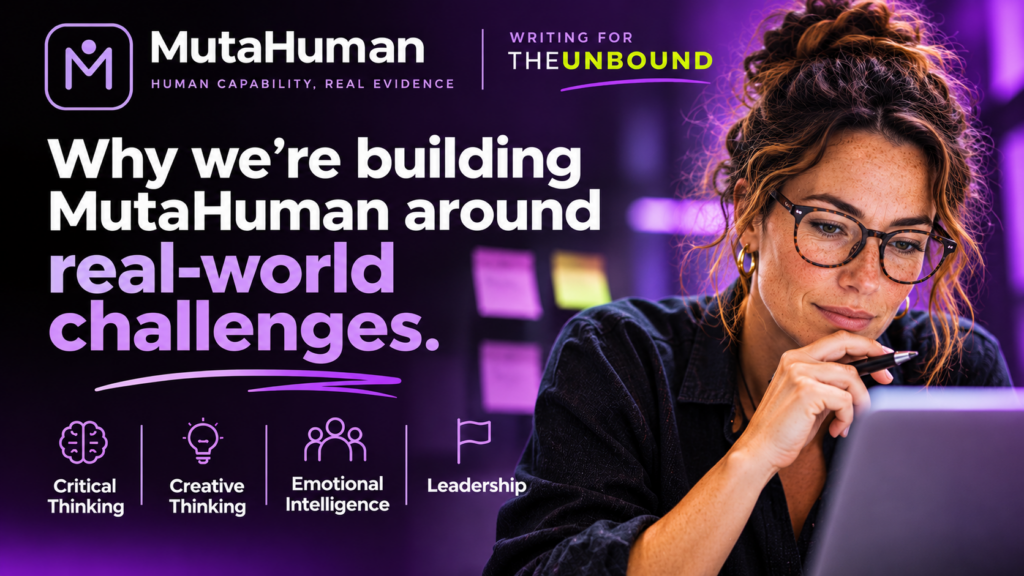
If we want to understand what people are capable of, perhaps we need to stop asking them to describe their abilities and start giving them meaningful opportunities to demonstrate them.
There’s a question we’ve been coming back to throughout the development of MutaHuman.
How do you know what someone is capable of?
Not what their job title suggests.
Not what their CV says.
Not what they’ve been trained to do.
But what they can actually demonstrate when they’re faced with something unfamiliar, complicated or unexpected.
It’s a deceptively difficult question.
And the more we’ve explored it, the more we’ve realised that answering it responsibly matters just as much as answering it at all.
That’s why we’re building MutaHuman differently.
Not around another personality questionnaire.
Not around a traditional competency checklist.
And certainly not around an AI system that claims to understand everything about a person after a few minutes of interaction.
We’re starting with something much more grounded.
Real work. Real decisions. Observable evidence.
We’ve become very good at asking people what they’re good at
Think about a typical job interview.
“Tell me about a time you demonstrated leadership.”
“Give me an example of when you solved a complex problem.”
“Describe a situation where you had to think creatively.”
These questions aren’t inherently bad.
They can provide useful information about someone’s experience, and structured interviews can form an important part of a fair assessment process.
But they also depend on something else.
A person’s ability to remember, select and communicate a convincing story.
Someone might be an exceptional problem-solver but struggle to describe their approach in an interview.
Another person might be brilliant at presenting their achievements but less effective when confronted with an unfamiliar problem.
And someone whose capabilities have developed outside conventional employment might not even recognise that their experiences are relevant.
We end up assessing a combination of capability, opportunity, memory, communication and confidence.
Then we try to separate those things in our heads.
What if we could observe more of the thinking itself?
Not perfectly. Not without limitations.
But more directly than we often do today.
Start with what people actually do
One of the earliest decisions we made about MutaHuman was that we shouldn’t begin by telling people what capabilities we wanted them to demonstrate.
Instead, we wanted to understand their real contributions.
The work they’ve done.
The decisions they’ve made.
The problems they’ve encountered.
The situations where they’ve had to exercise judgement, adapt their approach or work through uncertainty.
And importantly, the contributions that might never have appeared in their job description.
Someone might describe resolving a difficult customer situation.
Another might talk about managing an unexpected operational problem.
Someone else might describe coordinating care, organising a community initiative or finding a way to make an inefficient process work better.
We’re interested in what happened, what the person actually contributed and what evidence might support their account.
Because capability doesn’t necessarily arrive neatly packaged inside a job title.
And if we only look where traditional systems tell us to look, we’re likely to miss things.
But real-work stories are only one part of the picture.
They’re valuable because they provide context.
They aren’t automatically proof of every capability someone might claim.
Which brings us to the second part of our approach.
Give people something meaningful to work through
We’re developing practical challenges that ask people to engage with realistic situations.
Not abstract puzzles designed to produce a clever answer.
Not questions where there’s one hidden correct response.
But situations that involve competing priorities, incomplete information, changing circumstances and decisions that have consequences.
The kinds of complexity people encounter in actual work.
Imagine being presented with an operational problem.
A service is about to launch.
Information from different sources doesn’t agree.
There are concerns about customer welfare.
A technology system has produced an output that might be unreliable.
Different stakeholders want different things.
What do you do?
Where do you begin?
What information do you need?
What risks do you recognise?
What might you challenge?
And how does your approach change when new information becomes available?
We’re interested in the reasoning behind the decisions.
Because two people might choose the same course of action for very different reasons.
And two people might choose different approaches that are both reasonable, depending on the assumptions they’ve made.
The decision matters. But understanding how someone arrived at it can matter just as much.
Four capabilities. Many different ways to demonstrate them.
Our initial work focuses on four areas.
Critical thinking. How someone examines information, questions assumptions, recognises uncertainty and makes reasoned judgements.
Creative thinking. How they explore alternatives, connect ideas and develop approaches that move beyond the obvious.
Emotional intelligence. How they recognise and respond to the human implications of a situation, including the needs and perspectives of others.
Leadership. How they take responsibility, influence direction, navigate competing priorities and help move a situation towards a meaningful outcome.
These are deliberately broad areas.
They don’t represent everything a person is capable of.
Nor do we assume that one challenge can provide sufficient evidence across all four.
We’re exploring what can reasonably be observed, which interpretations are supported and where the limitations lie.
Because there’s an important difference between identifying evidence of a capability and claiming to have measured the whole person.
And we don’t want to confuse the two.
What we don’t observe matters too
This has become one of the most important principles in our development work.
Imagine someone completes a challenge but doesn’t demonstrate a particular aspect of leadership.
What does that mean?
Does it mean they lack leadership capability?
Or did the challenge simply not provide an appropriate opportunity to demonstrate it?
Perhaps they interpreted the situation differently.
Perhaps the relevant decision never arose.
Perhaps the evidence was too ambiguous to support a conclusion.
These distinctions matter.
We’re exploring evidence descriptions that distinguish between what is supported, what is emerging, what hasn’t been observed and what cannot reasonably be assessed.
Those descriptions apply to the strength of the evidence, not to the worth or potential of the person.
Someone who hasn’t demonstrated a capability in a particular exercise hasn’t necessarily failed.
We may simply not know enough.
That might sound obvious.
But it’s remarkably easy for an assessment system to turn an absence of evidence into an assumption of inability.
We want to resist that.
Not observed doesn’t mean not capable.
And what about AI?
Of course, we’re exploring how AI might support this process.
It would be strange to build a new approach to human capability discovery without considering what technology could make possible.
But we’re also conscious of the risks.
AI can produce convincing explanations.
It can identify patterns.
It can organise information.
And it can generate outputs that look remarkably authoritative.
None of that automatically makes its conclusions accurate, fair or appropriate.
Particularly when those conclusions concern people.
We’re not interested in creating a system that generates an impressive-looking capability score without being able to demonstrate what the score actually means.
Or one that makes consequential decisions about individuals based on interpretations that haven’t been properly tested.
Our early challenges are designed in advance rather than improvised by AI during an assessment.
We’re exploring structured evidence capture, human review and clearly defined limits on what can be concluded.
We’re also considering how individuals retain appropriate control over what they share and how organisations access information.
The technology should help us work with evidence responsibly.
It shouldn’t become a substitute for evidence.
AI should support our understanding of human capability, not manufacture certainty about it.
Why we’re starting small
There’s a temptation when developing something new to move as quickly as possible.
Build the platform.
Launch the product.
Generate the dashboard.
Start selling the solution.
And there’s certainly pressure to do that in a market where AI products seem to appear almost daily.
But we’ve deliberately chosen to begin with a small pilot.
We’re testing a paper-based prototype before attempting to automate the experience.
We’re working with volunteers from different professional backgrounds.
We’re looking at whether the challenges are understandable, whether the evidence is meaningful and whether reviewers can interpret it consistently.
We’re also looking for the things that don’t work.
Where instructions are unclear.
Where an exercise creates unintended advantages.
Where reviewers disagree.
Where our assumptions turn out to be wrong.
And where we simply don’t have enough evidence to make a reasonable judgement.
That’s not a failure of the development process.
That’s the development process.
We’re not yet claiming that MutaHuman can reliably measure these capabilities or predict how someone will perform in a future role.
Those are questions that would require substantial further research and validation.
Right now, our job is to understand whether we’re collecting useful evidence in the first place.
Because a beautifully designed platform built on an unreliable methodology would still be an unreliable assessment.
Just with a better interface.
This isn’t about replacing human judgement
One of the things we keep coming back to is that understanding human capability should remain a human-centred process.
We’re not trying to create a machine that decides who has potential.
We’re trying to explore whether better evidence could help people and organisations ask better questions.
For an individual, that might eventually mean being able to demonstrate capabilities that their career history doesn’t adequately reflect.
For an employer, it might mean discovering transferable capabilities within their existing workforce.
For someone changing careers, it could mean having another way to show what they can contribute.
And for organisations redesigning work around AI, it might provide a more informed starting point for understanding where human capability matters.
These are possibilities we’re working towards, not outcomes we’ve already proven.
But they’re possibilities worth exploring.
Especially when we consider how much of today’s working world is still organised around assumptions about people.
The bigger question is about how we design work
This series began by questioning the CV.
Then we explored whether some of what we describe as a skills gap might actually be an evidence gap.
But underneath both questions sits something bigger.
What if our understanding of people is being limited by the way we’ve designed work?
We create jobs.
We define responsibilities.
We decide what experience qualifies someone to perform them.
Then we use those structures to judge what people are capable of.
But as the nature of work changes, particularly through the growing relationship between human and digital capability, those assumptions become increasingly difficult to defend.
The independent FusionWork™ research led by Bloor Research explores the wider implications of redesigning work around human and digital contribution.
MutaHuman is approaching a related challenge from the perspective of the individual.
How might we better understand the human capability available to contribute to that redesigned work?
Because if we want to build organisations around what people and technology can each do best, we need to understand more than the roles people currently occupy.
We need to understand their capabilities.
And we need credible evidence to support that understanding.
We’re not building a better label for people
Perhaps that’s the most important thing to understand about MutaHuman.
We don’t want to replace job titles with another set of labels.
We don’t want to replace CVs with a numerical ranking.
And we don’t want to create a system that claims to know someone’s limits.
We want to explore a different starting point.
One that recognises people have capabilities their formal employment history may never have captured.
One that creates meaningful opportunities to demonstrate those capabilities.
One that acknowledges uncertainty rather than hiding it.
And one that helps individuals and organisations make more informed decisions without pretending that a single assessment can tell us everything.
We’re at the beginning of that journey.
There’s plenty still to learn.
And we’re quite prepared to discover that some of our assumptions need changing along the way.
Because if we’re serious about understanding human capability, we have to be willing to challenge our own thinking too.
The future of work shouldn’t be built around what we assume people can do.
It should begin with a better understanding of what they can demonstrate, and the possibilities we haven’t yet given them the opportunity to explore.
That’s why we’re building MutaHuman.
And that’s why we’re starting with real-world challenges.
MutaHuman is part of the WRKUNBOUND group. We are currently developing and testing an evidence-led approach to human capability discovery. The methodology is in early pilot development and has not yet been validated for employment selection, workforce ranking or other consequential decisions.
Explore MutaHuman: https://mutahuman.uk/
This is the third and final article in MutaHuman’s introductory series for THEUNBOUND.