When imitation becomes intelligence, are we building something that understands the world, or something that simply looks like it does?
There’s something rather unsettling lurking in the world of Minecraft.
And no, I’m not talking about the Creeper.
I’m talking about the Mimic Dweller.
For those unfamiliar with Minecraft, it’s a game built around exploration, creativity, survival and occasionally being scared witless by something emerging from the darkness.
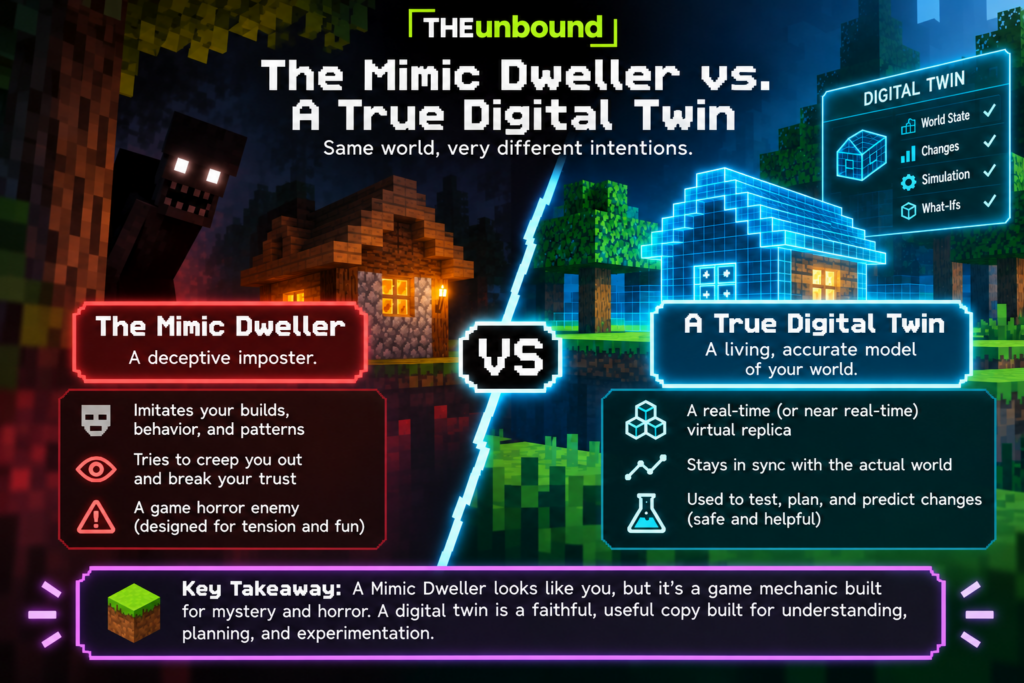
The Mimic Dweller, found in the game’s modding community, takes that experience to another level.
Depending on the version, it can imitate familiar appearances, sounds or behaviours, making players question whether what they’re encountering is really what it seems.
It’s clever. It’s creepy. And it’s a rather brilliant metaphor for something happening in the world of artificial intelligence.
Because right now, we’re getting very good at building things that mimic us.
AI can write like us, speak like us, recreate our faces, reproduce our working patterns and increasingly perform tasks that previously required a human.
But there’s a question we don’t seem to be asking nearly enough.
Just because something can imitate you, does that mean it understands you?
And perhaps more importantly, is imitation actually what we should be trying to achieve?
Meet the Mimic
Imagine walking through your Minecraft world.
You’ve spent hours building something. You know the landscape, the structures and the creatures that inhabit it.
Then something appears that looks familiar.
It behaves in a way you recognise.
But something isn’t quite right.
That’s the premise that makes a mimic so unsettling. It exploits our tendency to trust what we recognise.
And it’s not entirely unlike our relationship with generative AI.
Give an AI system enough examples of someone’s writing and it can produce a remarkably convincing imitation.
Feed it recordings of someone’s voice and it can generate speech that sounds like them.
Provide it with historical decisions, emails, meeting notes and working patterns, and it may begin to predict how that individual would respond to certain situations.
Impressive? Absolutely.
But understanding?
That’s a different question.
Reproducing an observable behaviour isn’t the same as understanding the capability behind it.
An AI might imitate how a manager communicates without understanding the relationships, judgement and emotional intelligence that make that manager effective.
It might reproduce a recruiter’s screening decisions without recognising the potential of someone whose career doesn’t fit the expected pattern.
It might replicate an organisation’s existing workflow perfectly.
Including every inefficiency, unnecessary approval and outdated assumption built into it.
Which raises an uncomfortable possibility.
What if we’re spending billions teaching AI to copy the very ways of working we should be redesigning?
Enter the Digital Twin
Digital twins are often discussed in the same breath as AI, but the underlying concept is quite different.
A genuine digital twin isn’t simply something that looks or behaves like its real-world counterpart.
It’s a digital representation of a specific physical asset, process or system, connected to relevant real-world information and designed to help us understand, monitor or simulate what happens to it.
Think of a wind turbine.
A digital twin might use operational data to help engineers understand its condition, anticipate maintenance needs or test how different circumstances could affect performance.
Or consider a manufacturing facility.
Rather than simply reproducing what the factory currently does, a digital twin can help teams explore what might happen if they changed production schedules, equipment configurations or operating conditions.
The important distinction isn’t whether the digital version looks convincing.
It’s whether the model is sufficiently grounded in reality to be useful for its intended purpose.
And whether it helps us make better decisions.
Not all digital twins operate in real time, and not every AI simulation qualifies as one. Accuracy, relevant data, validation and a clear relationship with the real-world counterpart matter.
A mimic is concerned with resemblance.
A digital twin is concerned with representation, understanding and useful experimentation.
And that distinction becomes particularly important when we start talking about people.
Can You Really Build a Digital Twin of a Human?
Now things get interesting.
Because humans aren’t wind turbines.
We’re not factories.
And we don’t operate according to entirely predictable rules.
Our capabilities evolve. Our motivations change. Our decisions are influenced by relationships, circumstances, experience, confidence, emotion and context.
The person you are at work today isn’t necessarily the person you could become tomorrow.
And the work you’re currently doing isn’t necessarily representative of everything you’re capable of doing.
Yet much of our organisational understanding of people is built on historical evidence.
Your CV tells us where you’ve worked.
Your job description tells us what someone expected you to do.
Your performance review tells us how you’ve been assessed against a particular set of expectations.
Your digital footprint might tell us how you communicate, collaborate and complete tasks.
But none of these provides a complete picture of your capability.
And combining them into an AI model doesn’t magically solve that problem.
It might simply produce a more sophisticated representation of an incomplete understanding.
We risk creating digital mimics of people’s employment histories and mistaking them for digital twins of their potential.
That’s a pretty significant distinction.
The Problem With Copying the Job
This is where the conversation connects directly to Bloor Research’s FusionWork™ research.
For decades, organisations have largely designed work around jobs.
We’ve grouped activities into roles, attached job descriptions, created reporting lines and built entire organisational structures around the assumption that the job is the fundamental unit of work.
Then along comes AI.
And what do we do?
We ask which jobs it can replace.
Which tasks it can automate.
How closely it can reproduce the work currently being performed by humans.
In other words, we’re asking AI to mimic the existing operating model.
But what if the operating model itself is the problem?
What if the job description doesn’t accurately reflect the work?
What if activities have accumulated over time because of organisational habits rather than necessity?
What if the most valuable human capability is hidden beneath administration, process and routine?
And what if automation gives us an opportunity to redesign the work entirely?
This is the difference between simply introducing AI into existing jobs and deliberately designing work around the combined capabilities of humans and digital systems.
It’s the difference between imitation and transformation.
FusionWork™: Beyond the Mimic
FusionWork™ describes the emerging category of work in which human and digital workers operate together.
Bloor Research’s work defining this category challenges us to consider a different question.
Not, “How do we make AI do what humans currently do?”
But:
“If we could design work around the best capabilities of humans and digital systems, what would that work look like?”
That’s a much more interesting challenge.
It requires us to understand the actual work being performed, the outcomes we’re trying to achieve and the different capabilities needed to deliver them.
Some activities may be suitable for automation.
Others may benefit from AI augmentation.
Some will continue to require distinctly human judgement, creativity, emotional intelligence, leadership and accountability.
And many will involve a combination.
But the objective isn’t to build a digital imitation of the employee.
It’s to create an operating model where human and digital capabilities are deliberately designed to work together.
This is also where properly constructed digital twins could become incredibly useful.
Imagine being able to model an organisational workflow and explore different configurations of human and digital labour before implementing changes.
What happens if we automate a particular process?
Where do decisions become bottlenecks?
Which human capabilities become more important?
What new risks emerge?
How might the work need to be redesigned?
A well-designed digital representation could help organisations explore those questions.
Not as an unquestionable prediction of the future, but as a way to test assumptions and make more informed decisions.
That’s a very different ambition from teaching an AI agent to impersonate someone doing their existing job.
And What About Human Potential?
There’s another dimension to this that I find particularly fascinating.
If we’re going to redesign work, we need a better understanding of what people are actually capable of.
Not simply what they’ve done before.
Because a person who has spent ten years in an administrative role may possess exceptional problem-solving ability.
Someone whose CV suggests a fairly conventional career might demonstrate remarkable leadership when faced with an unfamiliar challenge.
And someone who has never managed a team might have precisely the emotional intelligence and decision-making capability needed in a newly designed operating model.
Historical data alone won’t necessarily reveal any of that.
Which means the future of human capability assessment can’t simply be about creating increasingly detailed digital copies of people’s past.
We need better ways of discovering, observing and evidencing what people can do.
And we need to recognise that even the strongest evidence is contextual, not a permanent or complete definition of a person.
This is particularly important as AI begins to influence recruitment, workforce planning, development and organisational design.
We should be using technology to reveal human potential, not to trap people inside digital representations of who they used to be.
So, Are We Building Digital Twins or Mimic Dwellers?
Let’s return to Minecraft.
The Mimic Dweller works because it exploits familiarity.
It convinces you that what you’re seeing is something you recognise.
Until you discover that resemblance isn’t reality.
And perhaps that’s the warning for organisations rushing to embrace AI.
A system that sounds like your employees, reproduces their decisions or performs their existing tasks might be incredibly useful.
But it isn’t necessarily a digital twin.
And it certainly isn’t proof that we understand the full extent of their capability.
We need to stop confusing imitation with understanding.
We need to stop treating existing jobs as the inevitable blueprint for future work.
And we need to start designing organisations around what humans and digital systems could achieve together.
Because the most exciting opportunity presented by AI isn’t creating a perfect copy of the world we’ve already built.
It’s discovering what becomes possible when we’re no longer constrained by it.
And if we can do that without a terrifying Minecraft creature lurking around the corner, even better.
About THEunbound
THEunbound is where we challenge conventional thinking about work, people and technology. Exploring the ideas, evidence and perspectives shaping what comes next.
Part of WRKUNBOUND.
Rethink work. Unleash potential.
We’re WRKUNBOUND. Five businesses doing work differently.
From flexible employment and recruitment to the fusion of human and digital capability, we’re not here to do more of the same.
We’re here to change what’s possible.